
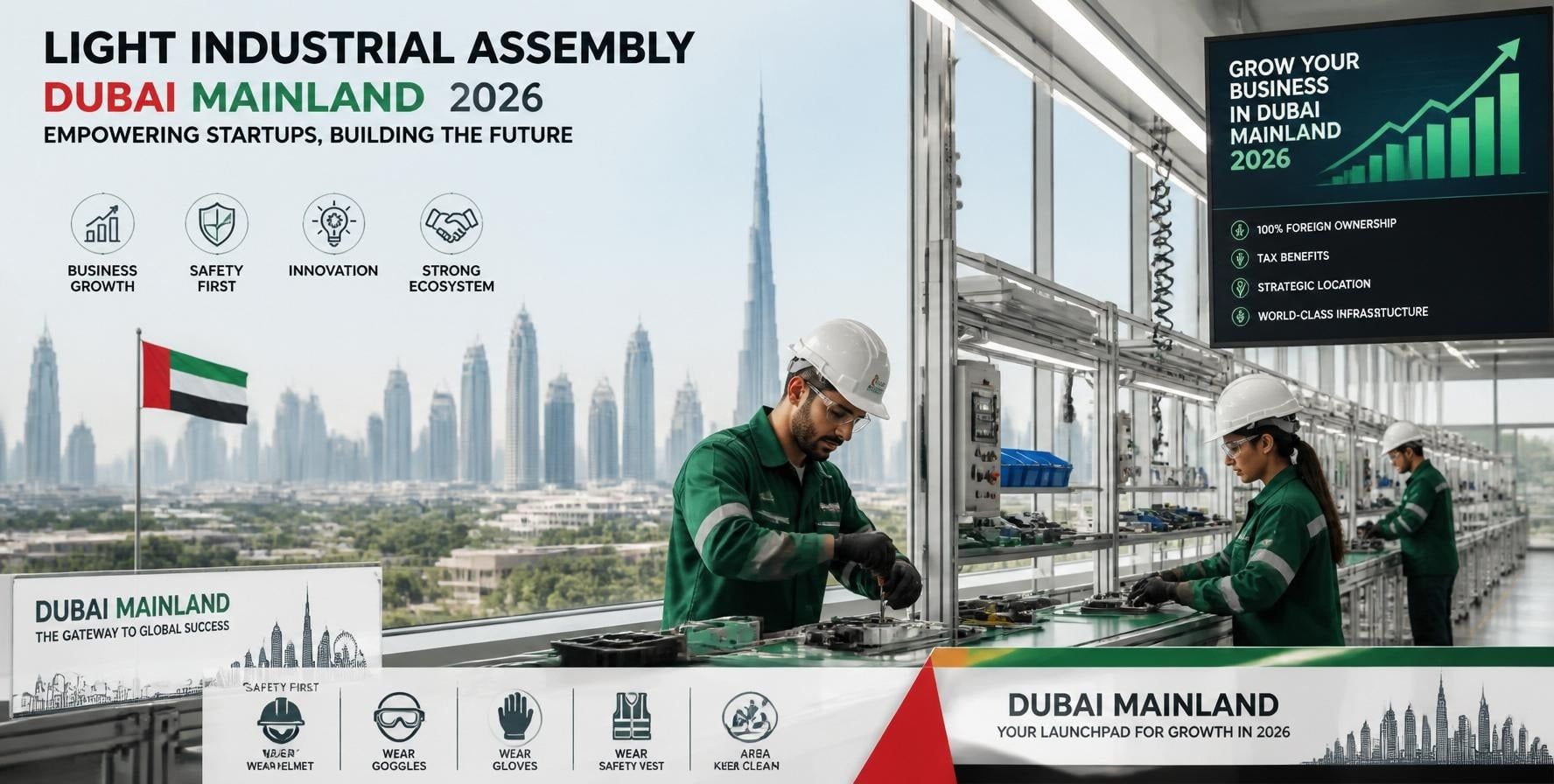
Why Is “Light Industrial Assembly” the Safest Business Plan For 2026 Dubai Mainland Startups?
Heavy manufacturing often requires massive investments in machinery, specialized facilities, and complex supply chains, whereas light industrial assembly focuses on assembling finished or semi-finished products using relatively simple processes. Startups entering the Dubai Mainland in 202 can achieve an appealing balance between profitability and practicality with this model. If you’re looking for a business idea that can scale steadily and keep operational risks under control, this blog will guide you on why light industrial assembly deserves serious consideration.
Setting up a business in Dubai is no longer just exciting, but it has also become more competitive. New entrepreneurs are constantly searching for industries that offer steady demand, manageable operating costs, and room to grow without exposing themselves to unnecessary financial risk. That’s exactly where light industrial assembly enters the picture.
Why Light Industrial Assembly Fits Dubai Mainland’s Business Environment
Dubai Mainland is rapidly attracting entrepreneurs because it offers direct access to the local UAE market and is a gateway to regional and international trade. Light industrial assembly supports fast-moving industries without demanding the enormous investment associated with full-scale manufacturing, which aligns it naturally with this ecosystem.
1. Lower Startup Investment Without Sacrificing Growth
The biggest reason entrepreneurs choose light industrial assembly is its relatively low capital requirement. Businesses don’t need to invest millions in manufacturing equipment; they can start with essential assembly tools, warehouse space, quality control equipment, and trained workers.
This lower initial investment offers more flexibility to the founders. The money you will invest in expensive machinery can be used for marketing, inventory management, or expanding customer relationships. You can expand and scale the production capacity as the demand increases. Entrepreneurs often look for business plan writers near me to craft a strong foundation before a launch, as a well-structured strategy is crucial for a light assembly business.
2. Flexible Product Categories
When it comes to light assembly businesses, they aren’t just limited to one industry. According to market demand, entrepreneurs can assemble electronics, furniture, automotive accessories, packaging materials, promotional products, medical supplies, or consumer goods.
In changing economic conditions, this flexibility becomes particularly valuable. If the market slows, businesses can pivot to another product category without completely restructuring their operations.
3. Faster Business Operations
If you are choosing heavy manufacturing, then it might involve lengthy production cycles and complicated production lines. Businesses that choose assembly often work much faster, as they already get many pre-manufactured components.
The shorter production time of light assembly means faster customer deliveries, quicker inventory turnover, and healthier cash flow. This operational speed offers a competitive advantage for startups that depend on consistent revenue generation.
4. Growing Demand Across Multiple Industries
The growth of all industries in Dubai, including construction, healthcare, retail, logistics, hospitality, and e-commerce, relies on assembled products. Light industrial assembly businesses not only serve a single niche market but also frequently supply multiple industries simultaneously.
The large number of customers has reduced their dependency on a single source of revenue. That added stability helps startups navigate market fluctuations with greater confidence.
The Business Advantages That Make Assembly Safer Than Traditional Manufacturing
There is no startup that does not carry any risk. The main goal of businesses should not be eliminating uncertainty, but rather choosing a business model that keeps those risks manageable and creates opportunities for sustainable expansion.
● Easier Inventory Management
Businesses using light assembly maintain inventories of standardized components instead of large volumes of finished products. It helps to simply their storage and reduce the financial burden of unsold inventory.
If customer preferences change, it is often much easier to replace or update individual components than to dispose of completed products that no longer meet market demand.
● Reduced Operational Complexity
Businesses that choose traditional manufacturing, they require extensive production planning, sophisticated machinery maintenance, large engineering teams, and continuous equipment monitoring. Assembly operations are often considered to be more straightforward.
Simplifying the workflow will make it easier for startup owners to oversee quality control, train employees, and maintain consistent production standards. You can reduce costly interruptions with fewer operational complications.
● Better Scalability
Most of the startups fail just due to expanding too quickly. Light industrial assembly provides a more measured path for businesses towards growth.
As customer demand grows, businesses can add workstations, hire additional staff, increase warehouse capacity, or introduce new assembly lines. Manageable stages reduce financial pressure and maintain operational stability when the expansion happens.
● Improved Cash Flow
Assembly cycles are relatively short, so the products often reach customers much faster than in conventional manufacturing environments. Faster deliveries often lead to quicker payments and stronger cash flow.
Once the business has healthy cash flow, it allows startups to purchase inventory on time, cover operating expenses comfortably, and invest in future growth without depending on outside financing.
Steps to Start a Light Industrial Assembly Business in Dubai Mainland
You need thoughtful planning if you are choosing to launch an assembly business. The process of light assembly is more flexible than heavy manufacturing, but careful preparation plays a major role in long-term success.
1. Choose the Right Assembly Niche
First, identify the industries with consistent demand. You need to research local market trends, evaluate competitor offerings, and determine your focus on consumer products, industrial components, healthcare supplies, electronics, or specialized packaging. It is better to choose a niche with steady purchasing activity so that it provides a stronger foundation than chasing short-term trends.
2. Develop a Practical Business Plan
Must include your startup costs, supplier relationships, staffing requirements, pricing strategies, projected revenue and operational workflows in your business plan. A detailed roadmap will help founders to anticipate challenges before they arise and make future expansion decisions much easier. You need the same level of detailed planning across industries, whether you are writing a restaurant business plan or preparing a roadmap for an assembly startup in Dubai Mainland.
3. Secure an Appropriate Facility
Assembly operations just need some functional workspaces instead of large manufacturing plants. You should choose a facility that supports efficient inventory storage, organized assembly stations, quality inspections, and smooth product dispatch. If you have an efficient layout, it will improve productivity and reduce unnecessary movement and operational delays.
4. Build Reliable Supplier Partnerships
Suppliers play an important role in influencing production quality and delivery schedules. Must evaluate multiple vendors based on pricing, reliability, consistency, and communication before making long-term commitments with anyone. It is important to maintain relationships with backup suppliers to minimize disruptions if one vendor experiences delays.
5. Focus on Quality and Continuous Improvement
You should do quality assurance at the part of every production stage rather than just doing it in a final inspection process. Build standardized procedures, document assembly instructions, train employees regularly, and encourage continuous process improvements. Consistent product quality can help you build customer trust, strengthen your reputation, and generate repeat business over time.
Preparing Your Assembly Startup for Long-Term Success in 2026
The step to launching the business is just the first part. The sustainable success of the business depends on adapting to market changes and continuously improving operations and customer satisfaction.
● Invest in Workforce Training
You need skilled employees for successful operations, even for simple assembly. Train your employees properly to reduce production errors, improve efficiency, and create consistent product quality. Employees who have an understanding of the standardized procedures can contribute valuable suggestions to improve workflows and increase productivity.
● Embrace Automation Gradually
You don’t always need expensive robotics for automation. Businesses can simply use barcode tracking, production scheduling software, digital inventory systems, and automated labeling solutions to improve operational efficiency without overwhelming startup budgets. Introduce your technology gradually to allow businesses to increase their productivity and control investment costs.
● Build Strong Customer Relationships
One of the greatest competitive advantages of startups is reliable communication. You can deliver your products on schedule, maintain consistent quality standards, and respond quickly to your customer queries. Frequently satisfied customers can become your repeat buyers, and they will also recommend your services to other businesses in their industry networks. Each successful business starts with proper planning, whether you think, ‘I should write my real estate business plan‘ or develop a scalable strategy for long-term growth in mind.
● Monitor Market Trends Continuously
Market trends are becoming important, and technology, customer preferences, and supply chain dynamics are continuously evolving. Businesses that are regularly monitoring industry developments can now identify new product opportunities before their competitors. Remaining adaptable allows assembly businesses to diversify product offerings and also maintain steady revenue streams during changing market conditions.
Frequently Asked Questions
1. What is light industrial assembly?
Light industrial assembly is about putting together pre-manufactured components to create finished products. It requires less machinery, lower investment, and simpler production processes than traditional manufacturing.
2. Why is light industrial assembly considered to be safer for startups?
Light industrial assembly often involves low startup costs, reduced operational complexity, faster production cycles, and easier scalability. These factors help businesses to minimize financial risk and allows to grow steadily.
3. Can a light industrial assembly business serve multiple industries?
Yes, many assembly businesses supply products to sectors such as healthcare, retail, construction, logistics, automotive, hospitality, and e-commerce and have more diversified revenue streams.
Final Thoughts
Light industrial assembly is one of the most practical and balanced startup opportunities in Dubai Mainland for 2026. It offers low startup costs with operational flexibility, scalable growth, faster production cycles, and access to various industries that are continuously expanding across the UAE.
Entrepreneurs can establish efficient assembly operations that generate consistent cash flow and remain adaptable to changing market demands, unlike heavy manufacturing, which can lead to a financial burden. The success of businesses depends on the right niche choice, building dependable supplier relationships, maintaining high-quality standards, and continuously improving business processes.

I write for the BusinessPlanDubai.AE blog to inspire and equip aspiring entrepreneurs with the tools they need to build compelling business plans and succeed in the UAE’s dynamic market. Backed by years of experience helping businesses articulate their vision and secure funding, I focus on delivering helpful tips, step-by-step guides, and expert insights into strategic business planning. Whether you’re launching your first startup or refining an investor proposal, my aim is to make business planning accessible, actionable, and effective.